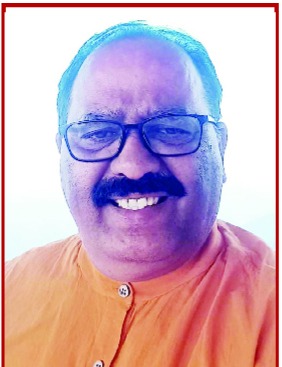
Remembering a Forgotten Legend: Ganithavadhani Lakkoju Sanjeevaraya Sharma
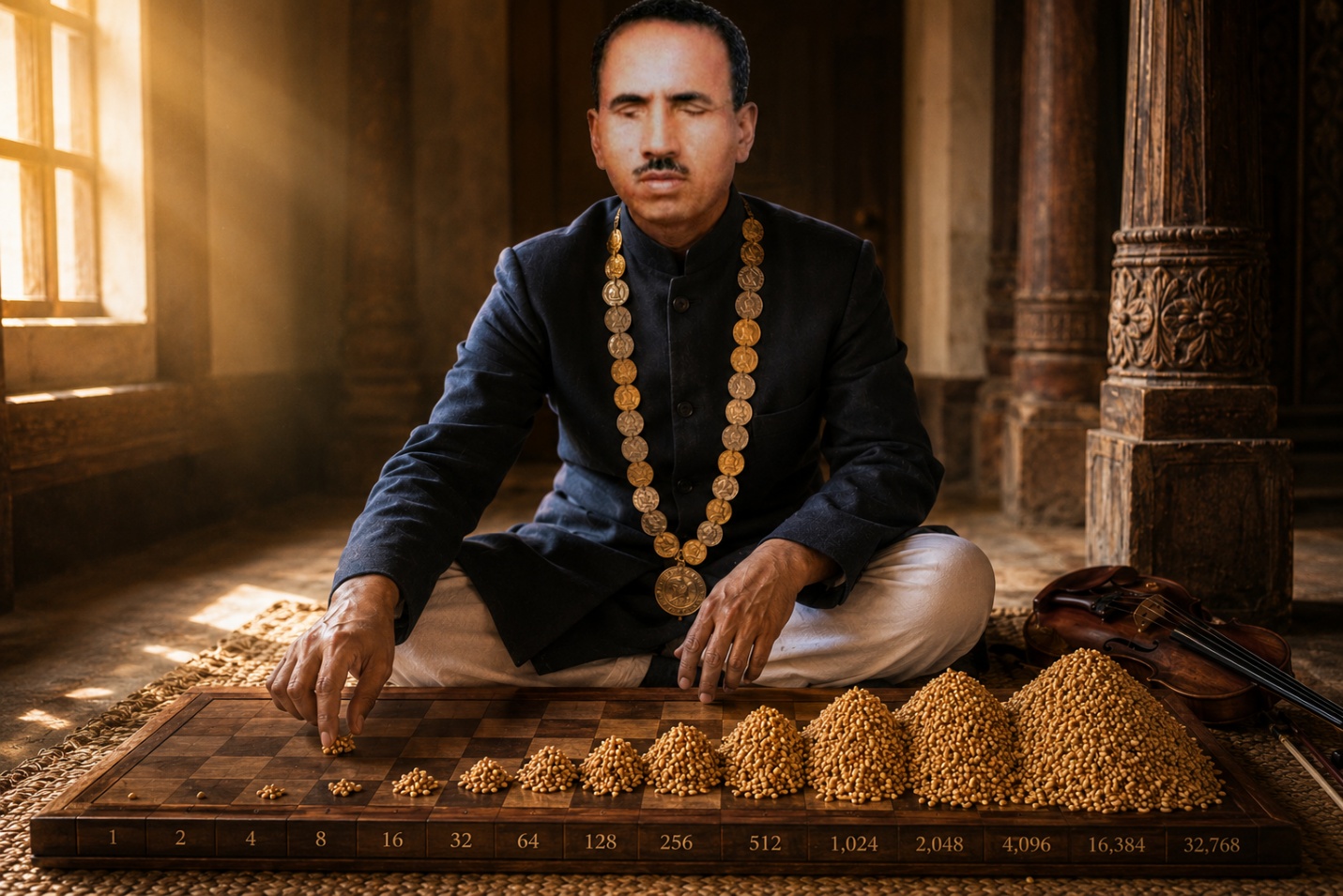
Born blind into a goldsmith family in Kalluru village, Andhra Pradesh, his mother fiercely protected him when a midwife suggested letting him die. Unable to attend formal school, Sharma learned mathematics, literature, and languages solely by listening to his sister, Akkamma, read her lessons aloud. Through this auditory immersion, he developed an extraordinary memory and taught himself to play the violin.
Sharma's public career launched in 1928 at the Andhra Mahasabha in Nandyal. The 21-year-old astonished politicians and scholars by instantly solving complex mathematical equations in his head while simultaneously playing the violin. This astounding performance earned him widespread recognition; a photograph taken by prominent freedom fighter and leader Tanguturi Prakasam Pantulu marks the historical record, and the event collected significant charitable donations for a local home for the disabled.
Throughout his life, Sharma gave mathematical demonstrations across the country. Following a 1931 performance, Madras Governor Sir George Stanley remarked that if Sharma had been born in England, a national statue would have been erected in his honour. In 1944, a local religious head bestowed upon him the prestigious title of "Ganitha Brahma".
His fame continued to expand into the 1950s as he performed before prominent dignitaries, including Andhra Pradesh Chief Minister Burgula Ramakrishna Rao. A celebrated 1953 demonstration highlighted his extraordinary mental agility when he calculated the classic, exponentially doubling wheat grains problem across all 64 squares of a chessboard.
Today, Lakkoju Sanjeevaraya Sharma and his blind mathematical wizardry have largely faded from public memory. A man who never attended a formal school yet conquered mathematics remains a living testament that completely demolishes the myth that blind individuals cannot master math.
Every year in India, we celebrate Louis Braille for his literacy system, and in enlightened institutions, Dr. Abraham Nemeth is celebrated for the Nemeth Braille Code for mathematics. Yet history is full of extraordinary blind thinkers who reshaped global mathematics.
World’s Legendary Blind Mathematicians
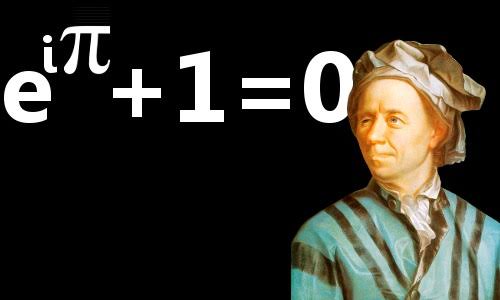
One of history's greatest mathematicians. Euler went completely blind in his 60s, yet his productivity increased. He calculated equations in his head and dictated over half of his 866 publications while blind, standardizing modern notation and Euler's Identity: (e^{ipi} + 1 = 0).
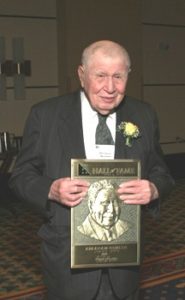
Born blind, Nemeth earned a Ph.D. in mathematics and became a university professor. In 1951, he invented the Nemeth Braille Code for Mathematics and Science Notation, which remains the global gold standard for blind scientists today.
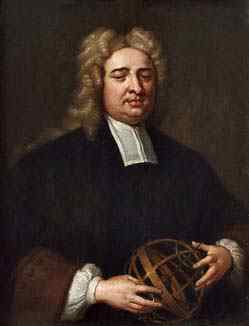
Blinded by smallpox in infancy, Saunderson held Cambridge University's Lucasian Chair of Mathematics for 28 years (a seat later held by Newton and Hawking). He invented "Palpable Arithmetic," a tactile pegboard for geometric and arithmetic calculations.
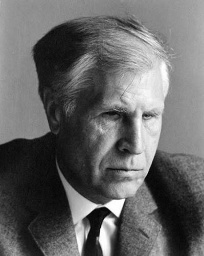
Lost his sight at age 14 due to a stove explosion. Learned mathematics with his mother reading papers aloud. Made seminal breakthroughs in algebraic topology and optimal control theory without ever visually seeing his formulas.
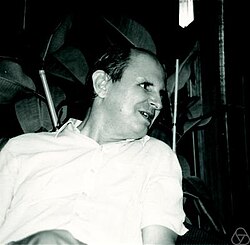
Lost sight at age six. Became a world-renowned geometer and topologist, famous for proving the theoretical "sphere eversion"—turning a sphere inside-out without creasing or tearing—entirely through mental geometric visualization.