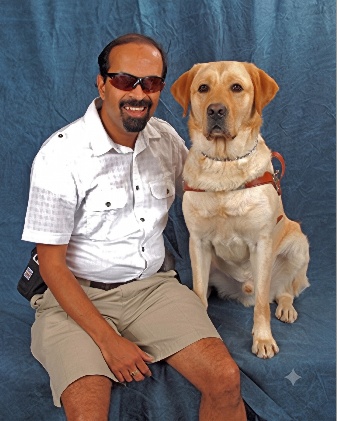
Dr. T.V. Raman: The Man Who Made Mathematics Digitally Accessible
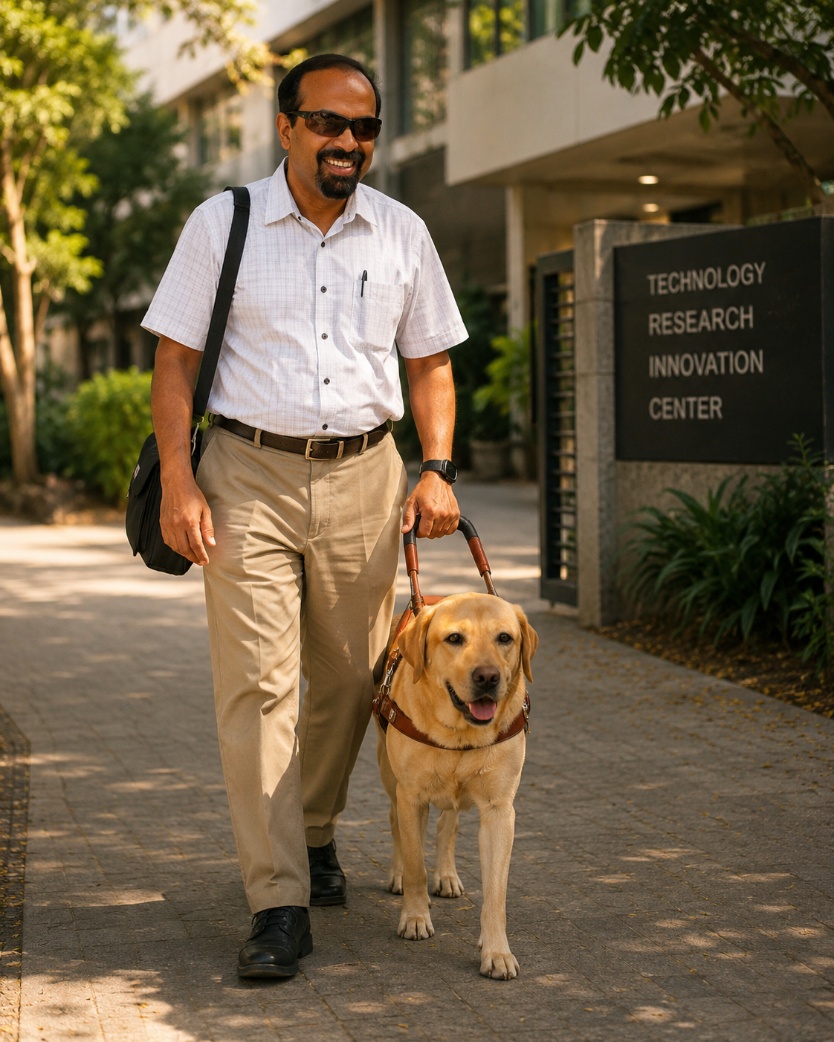
Dr. T.V. Raman, chairman of Chakshumathi, is a distinguished mathematician, computer scientist, and accessibility researcher whose work has fundamentally transformed how visually impaired individuals interact with complex technical information. His journey is a testament to mathematical brilliance and an unrelenting drive to make digital information universally accessible and eyes-free.
Early Education and Innovations
Born in Pune, India, Raman was partially sighted until the age of 14, when he lost his vision completely. Relying on his brother, mentors, and aides to read textbooks and problems aloud, he successfully earned a B.A. in Mathematics from the University of Pune.
He went on to earn an M.S. in Mathematics from the prestigious Indian Institute of Technology (IIT) Bombay in 1989. During his final year at IIT Bombay, he developed a pioneering program called "CONGRATS", designed to help users visualize mathematical curves by listening to their auditory representations.
Developing AsTeR at Cornell University
Driven by his desire to pursue advanced mathematics and facing a lack of adaptive computing equipment in India at the time, Raman moved to the United States to attend Cornell University, where he earned an M.S. in Computer Science and a Ph.D. in Applied Mathematics.
The Math Reading Barrier: Raman recognized that reading mathematical language aloud is inherently ambiguous. For instance, the spoken phrase "A plus B divided by C minus D" does not convey the structural grouping that is immediately obvious in written fractions.
The Innovation: For his doctoral thesis, he created AsTeR (Audio System for Technical Readings). The system processes complex mathematics formatted in LaTeX and renders it into clear, unambiguous audio. AsTeR utilizes varying pauses, voice pitch modulation, and structured phrasing (e.g., "The quantity A plus B, divided by C minus D") to accurately convey mathematical logic.
Global Recognition: His groundbreaking thesis detailing AsTeR was awarded the prestigious ACM Doctoral Dissertation Award in 1994.
Industry Impact, Recreational Mathematics & Fun with Maths
Dr. Raman has led accessibility innovations across major technology leaders in Silicon Valley. Alongside his professional work, he maintains a lifelong passion for recreational mathematics and polyhedral geometry. Remarkably, using a Braille version, he was known for being able to solve a Rubik's Cube in under 30 seconds during his school days.
Fun with Maths Project: Raman’s Fun with Math curriculum is currently being prepared for deployment on Chakshumathi’s LAAMS Learning Management System. The curriculum is designed for learners of all backgrounds—completely accessible, engaging, and structured to instill an early love for mathematical logic.